
Vibration sensor calibration, anywhere you work.
Battery-powered, A2LA-accredited portable vibration calibrators for accelerometers, velocity sensors, proximity probes and 4–20 mA transmitters, in the field, the lab or on the production line. Choose the AT2030 for a traceable reference vibration source, or the AT2040 to test, simulate and certify sensors from one case.
Two calibrators. Pick the one that fits the job.
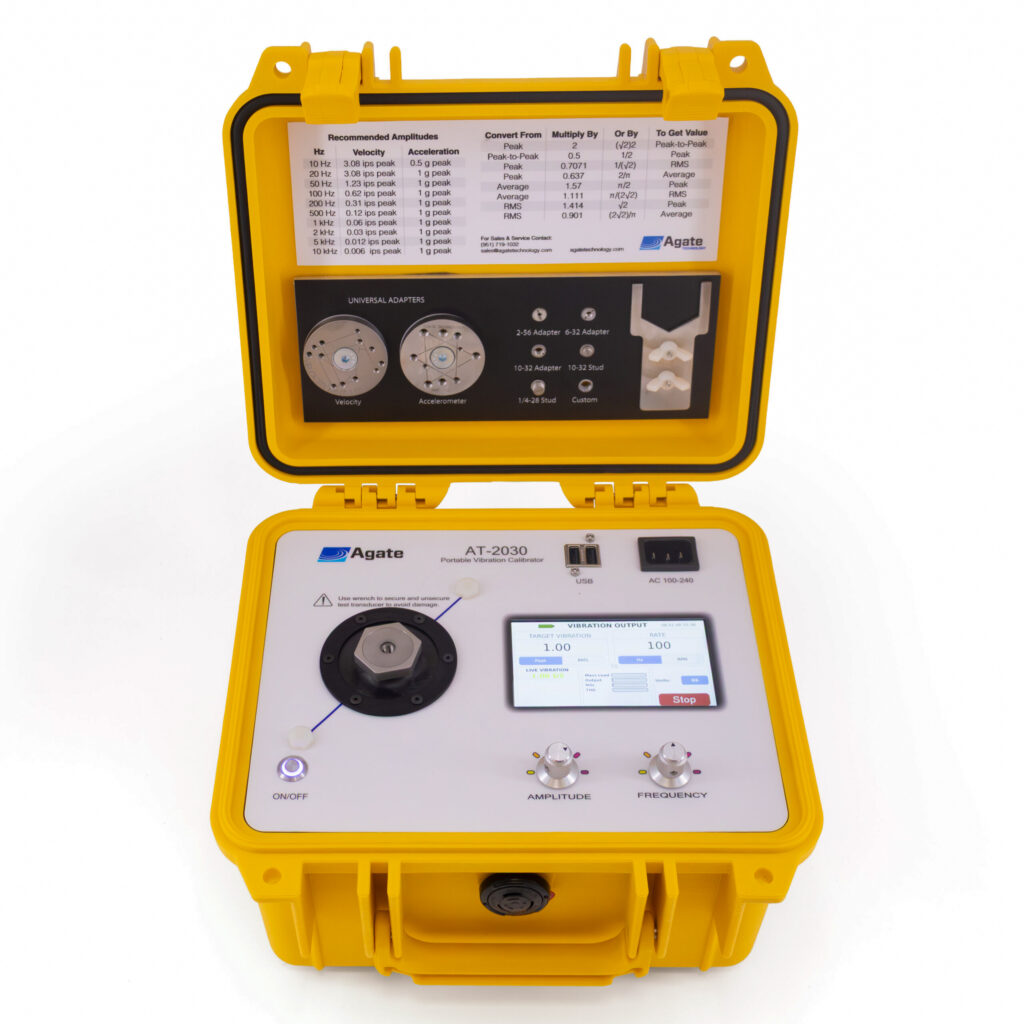
AT2030
Second-generation portable vibration calibrator. A traceable reference vibration source with live vibration, THD and mass-load readout.
| Platform | Gen 2 |
| Vibration output | 5 Hz – 10 kHz |
| Live display | Vibration level, THD, mass load |
| Sensor inputs | — |
| Sensor power | — |
| Automated tests & certificates | — |
| Signal simulation | — |
| Network remote control | Script commands and VNC, over Ethernet or Wi-Fi |
| Battery | 12 V 6 Ah LiFePO4, ~5,000 cycles |
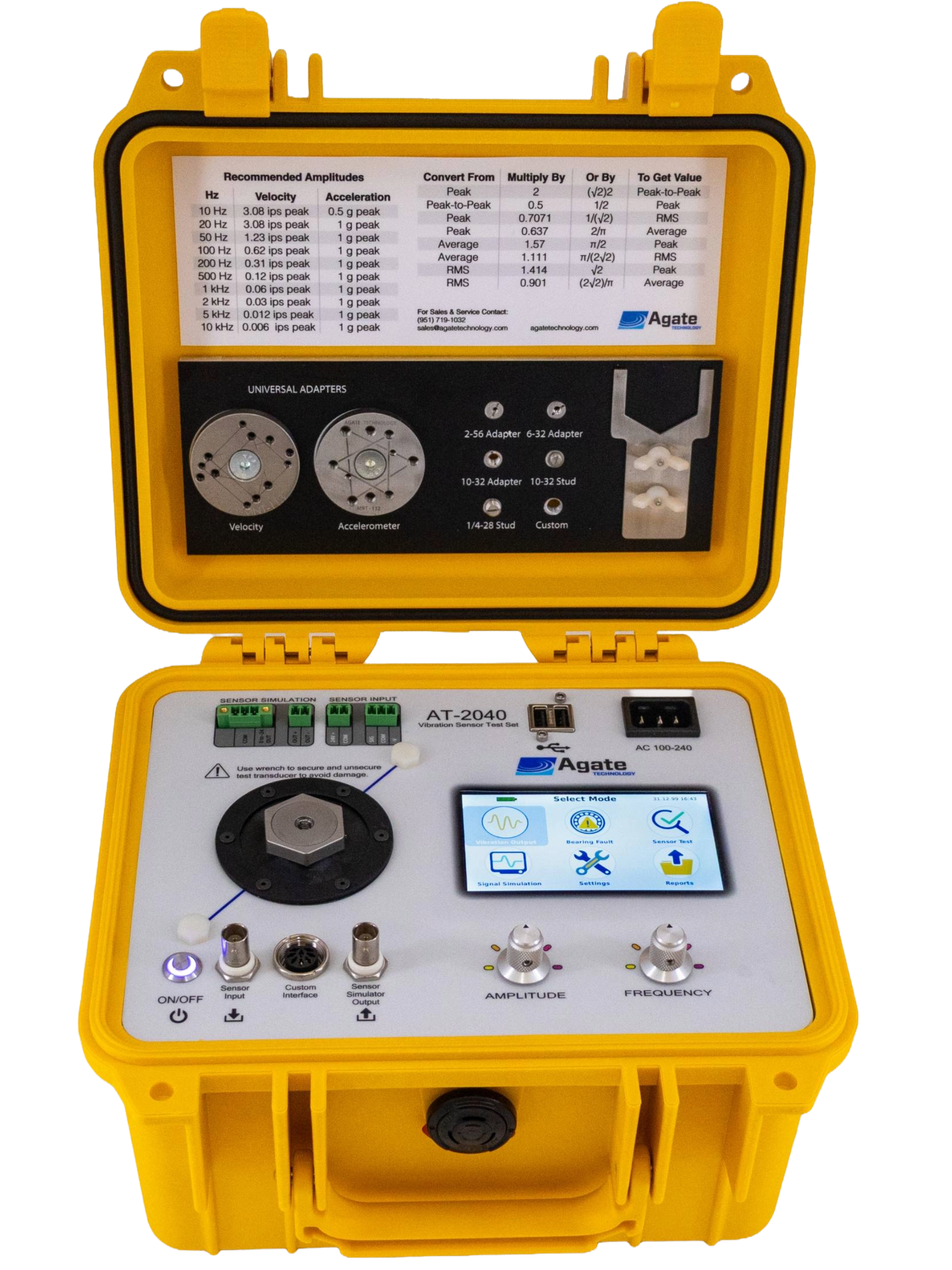
AT2040
Second-generation smart shaker, sensor test set and simulator. Everything you need to verify a sensor and the system it feeds.
| Platform | Gen 2 |
| Vibration output | 5 Hz – 10 kHz |
| Live display | Vibration level, THD, mass load, plus sensitivity and bias/gap voltage |
| Sensor inputs | ✓ Analog: IEPE, charge, voltage, velocity, proximity probe, 4–20 mA, MEMS (with adapter) |
| Sensor power | ✓ 2–24 V, −24 V, +24 V loop |
| Automated tests & certificates | ✓ PDF certs, CSV export |
| Signal simulation | ✓ 1 Hz – 11 kHz |
| Network remote control | Script commands and VNC, over Ethernet or Wi-Fi |
| Battery | 12 V 6 Ah LiFePO4, ~5,000 cycles |
If it measures vibration, plug it in.
The AT2040 powers and reads the analog output of nearly every common sensor type, with no separate supply, charge amp or meter. The AT2030 gives you the traceable reference vibration to check sensors with your own meter or analyzer.
IEPE accelerometers
Bias voltage, sensitivity and frequency response for industrial IEPE sensors.
Calibration guide → pC/gCharge-mode sensors
Direct charge input, so you don't need an external charge amplifier.
Calibration guide → mV/ipsVelocity sensors
Piezo and moving-coil sensors in ips or mm/s.
Calibration guide → mV/milProximity probes
Gap voltage, scale factor, linear range and dynamic response. Driver powered from the AT2040.
Calibration guide → 4–20 mALoop transmitters
Apply a known vibration level and check the loop current scales correctly. Impact transmitter support coming in 2027.
Calibration guide → V/gVoltage & MEMS
AC/DC voltage output, piezoresistive and variable capacitance sensors with the MEMS adapter.
Calibration guide →More than a shaker.
The AT2040 adds sensor inputs, onboard power, automatic testing and signal simulation, so one case replaces a bench of equipment.
Step-by-step guides for every sensor.
Calibration guides
Application notes
Vibration calibration questions, answered.
What is a portable vibration calibrator?
A battery-powered shaker with a built-in reference accelerometer that produces a known, traceable vibration level, so you can check or calibrate vibration sensors and monitoring systems on site instead of sending them to a lab.
Which should I choose, the AT2030 or the AT2040?
Choose the AT2030 if you need a traceable reference vibration source and read sensors on your own meter or analyzer. Choose the AT2040 if you also want the calibrator to power and read the sensor, show live sensitivity, run automated tests with PDF certificates and simulate signals. Both share the same Gen 2, 5 Hz – 10 kHz shaker.
What vibration sensors can you calibrate?
IEPE, charge and voltage accelerometers, piezo and moving-coil velocity sensors, eddy-current proximity probes, 4–20 mA vibration transmitters and, with the MEMS adapter, piezoresistive and variable-capacitance MEMS sensors. Our calibration guides walk through each type. Calibration guides
Is Agate calibration accredited and traceable?
Yes. Calibration of our calibrators is A2LA accredited to ISO/IEC 17025:2017 and NIST traceable.
Can the calibrators be controlled remotely?
Yes. Both the AT2030 and AT2040 support network remote control over Ethernet or Wi-Fi, with plain-text script commands over TCP and VNC screen control.
Do you offer recalibration and service?
Yes. We recommend annual recalibration. See Calibration & Service for details, or contact us for a quote. Calibration & Service
See it calibrate your sensors.
Tell us which sensors you test, and we'll send pricing and set up a live demo.