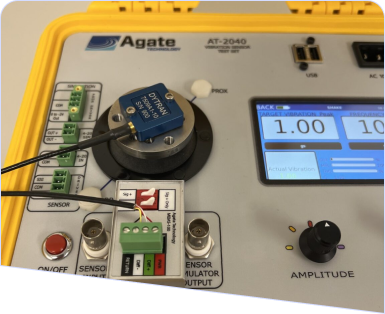
Portable Vibration Calibrator - Agate Technology

AT2040 Portable
Vibration Calibrator

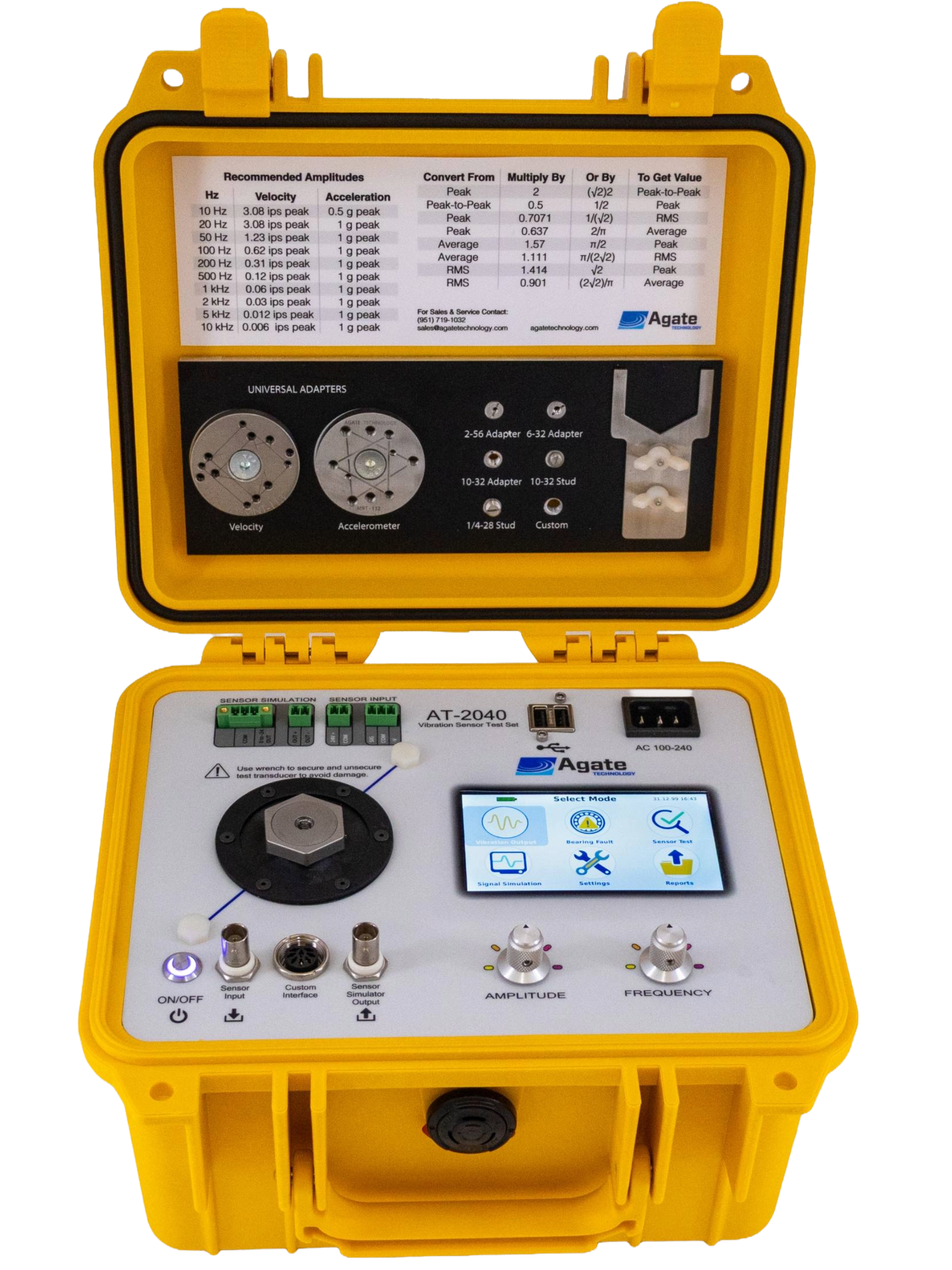
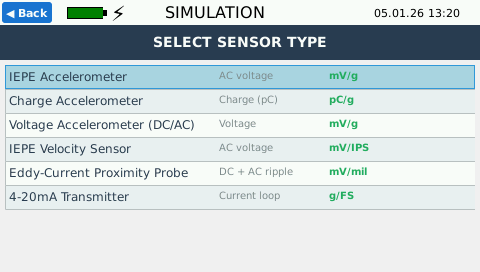
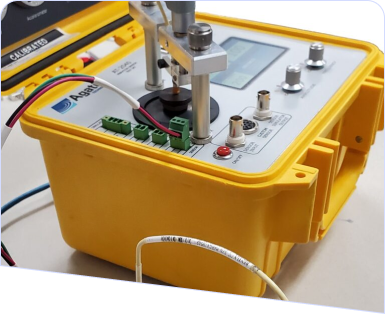
The AT-2040 Gen-2 Portable Vibration Calibrator provides multiple test modes for real-world vibration calibration, sensor verification, and analyzer validation. Each mode supports different workflows — from direct shaker excitation to sensor simulation and bearing fault reproduction — enabling comprehensive testing in the field or lab.

Different test methods to choose from

select_mode_screenshot

Vibration Output

screenshot_20251229_154956

Manually excite a mounted sensor or device using the built-in electrodynamic shaker with precise control of frequency and amplitude.

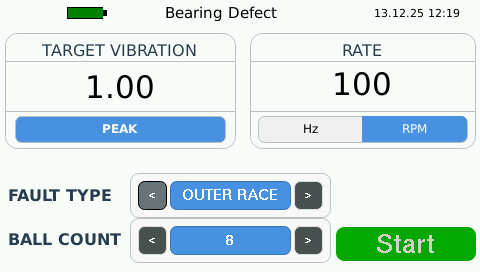
Bearing Defect

Bearing Fault Simulator

Generate realistic bearing fault signatures to validate analyzers, train personnel, or demonstrate diagnostic techniques—without rotating machinery.

Sensor Test

Vibration Sensor Automatic Testing


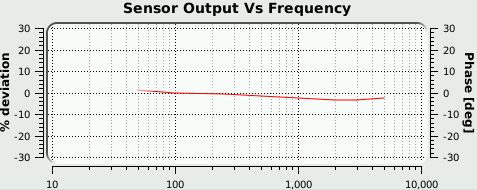
Perform multi-point sensitivity testing with automatic sweeps, live graphing, and onboard data storage.

Sensor Simulation

screenshot


Simulate the electrical output of vibration sensors without physical motion, acting as a vibration-specific function generator.

Vibration Output

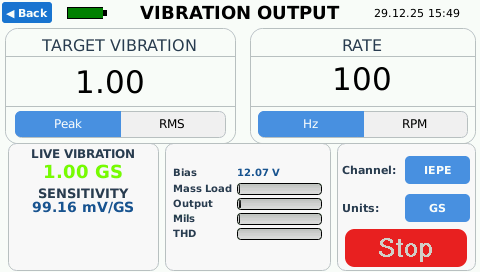
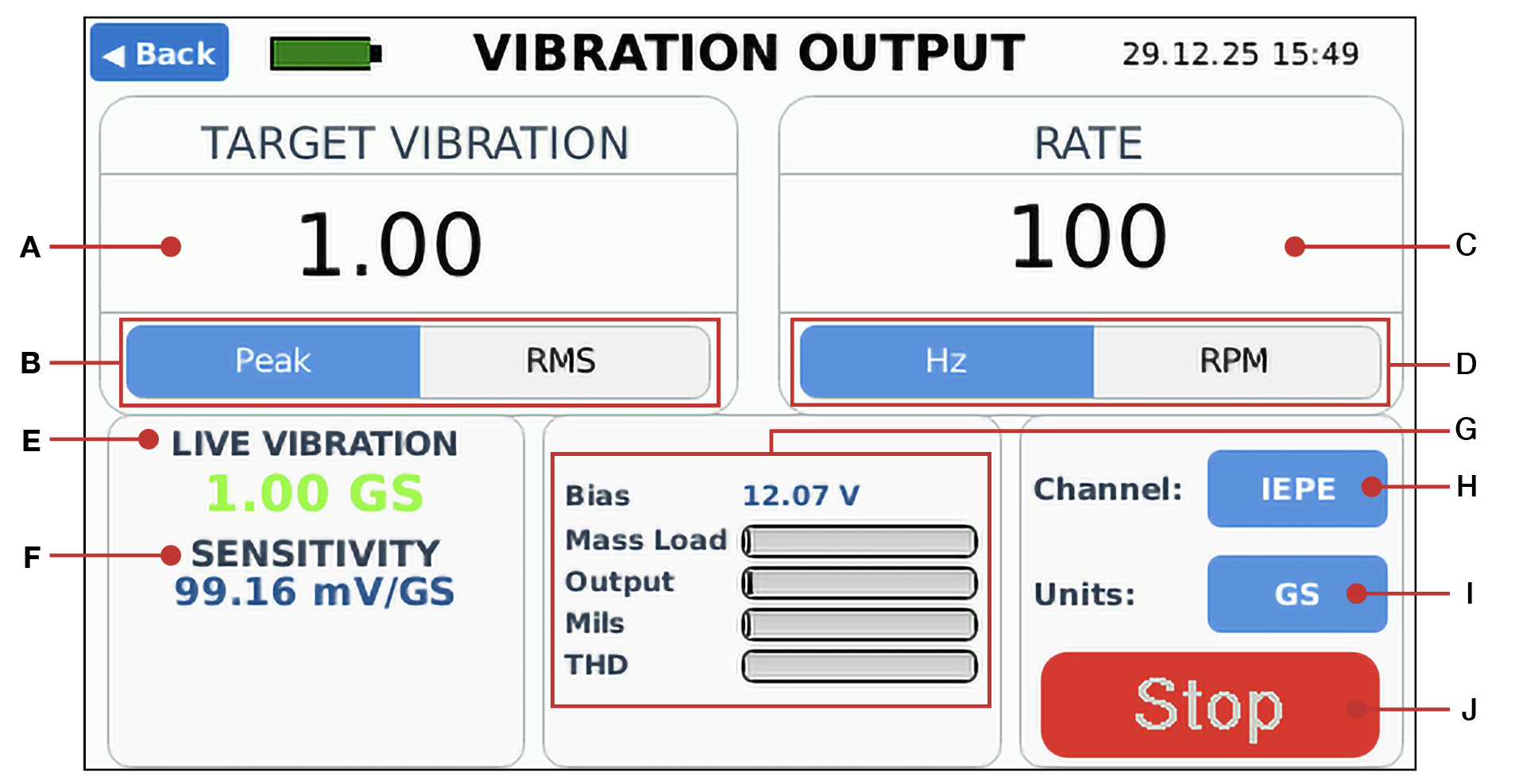
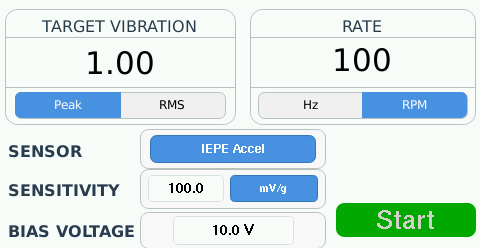
Vibration Output mode is used for manual vibration testing with real-time measurement of actual shaker output. Rather than assuming vibration levels based on drive settings, the AT-2040 continuously measures true mechanical motion using its internal reference sensor.

In this mode, the user manually sets vibration frequency and amplitude while the system provides live feedback on measured vibration level, sensor sensitivity, displacement, harmonic distortion, and amplifier load. This closed-loop approach allows users to confidently verify sensor performance and system response under real mechanical excitation.

Vibration Output mode is particularly useful for manual verification, troubleshooting, and exploratory testing, where direct control and immediate feedback are required before transitioning to automated test routines.

Supported sensors.

What this mode enables

Screen Reference

AT-2040 Vibration Output Overview
Ref Control Description
A
Target Vibration
Sets the vibration amplitude.
B
Peak/RMS Toggle
Switches the vibration measurement between Peak and RMS modes
C
Rate
Sets the vibration frequency or RPM
D
Hz / RPM Toggle
Switches the rate display between frequency (Hz) and speed (RPM).
E
Live Vibration
Displays the actual vibration output of the shaker
F
Sensitivity
Shows the measured sensitivity of the connected sensor.
G
Output Status
Displays bias or gap voltage, mass load, amplifier output level, and total harmonic distortion in real time.
H
Channel
Selects the active sensor input channel.
I
Units
Selects vibration units for live vibration and sensitivity display.
J
Start/Stop
Starts or stops the vibration output test.

Bearing Fault Simulation & Verification

The AT-2040 Gen 2 includes an integrated bearing fault pulse generator designed to simulate real bearing defect conditions for system testing, alarm verification, and training.

Unlike simple sine outputs, the bearing fault simulator produces repeatable, defect-style pulse patterns that allow users to validate condition monitoring systems without requiring a physical damaged bearing

Bearing Fault Simulator
Example of bearing fault pulse generation on AT-2040 Gen 2 Platform

Why This Matters

Condition monitoring systems detect bearing defects by identifying impulsive events and their repetition rates. The AT-2040 Gen 2 bearing fault simulator produces realistic impulse waveforms with natural decay, enabling validation of alarm thresholds, envelope detection, and system behavior without the need for a physical damaged bearing.

Commonly used for condition monitoring system validation, alarm threshold testing, and technician training.

Bearing Fault Waveform Behavior

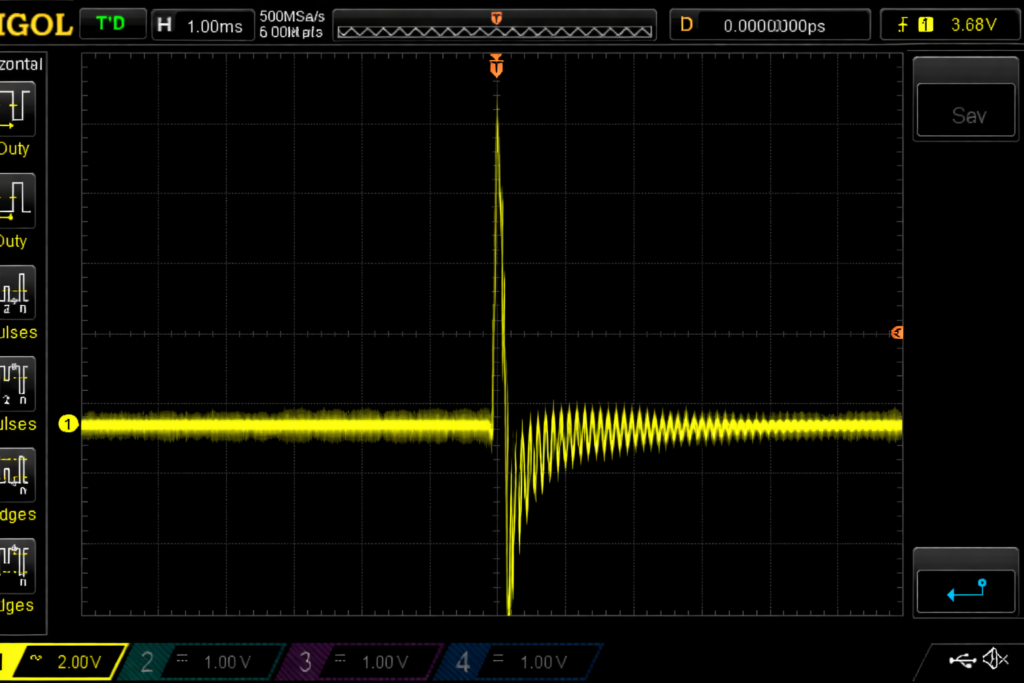
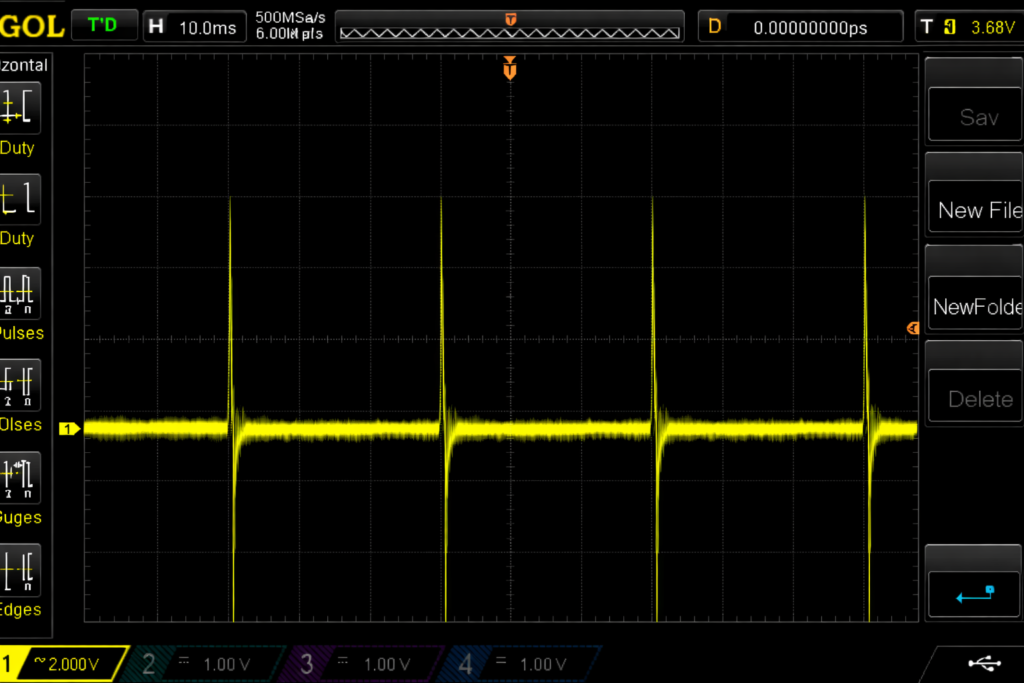
The oscilloscope captures shown below illustrate the waveform characteristics produced by the AT-2040 Gen 2 bearing fault simulation.

Each bearing defect is represented by a sharp impulse followed by a brief, decaying oscillation. The initial spike corresponds to the moment a rolling element contacts a localized defect, while the decaying response represents the mechanical resonance excited by that impact. This impulsive behavior reflects how real bearing faults generate vibration energy and differs from steady-state or sinusoidal signals.
When viewed over a longer time scale, the impulses repeat at a consistent interval. Each event represents a rolling element passing over the same defect, producing a stable and repeatable fault pattern. The spacing between impulses corresponds to the bearing fault frequency, allowing condition monitoring systems to respond as they would to an actual damaged bearing.

Automatic Sensor Test & Calibration

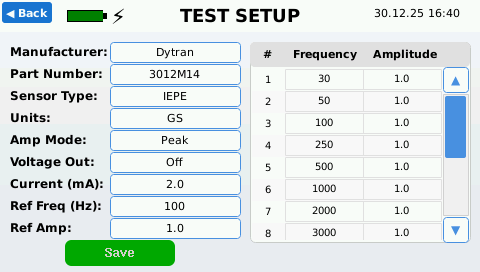
The Sensor Test mode automates vibration sensor calibration by controlling output levels, measuring response, and calculating sensitivity across defined test points.

This mode reduces setup time and eliminates manual calculations, providing consistent, repeatable results suitable for both field verification and laboratory use.

When to Use Sensor Test Mode

Use Sensor Test mode when verifying sensor sensitivity, performing routine calibration checks, or generating repeatable test results without manual setup or calculations.

Vibration Sensor Automatic Testing
Automatic Test Configuration for Dytran 3010M14 sensor.
Table View of Dytran Sensor Test
Graph View of Dytran Sensor Test
Automatic Test Configuration for Proximity Probe AC Dynamic Test
Table View of Proximity Probe Automatic Test
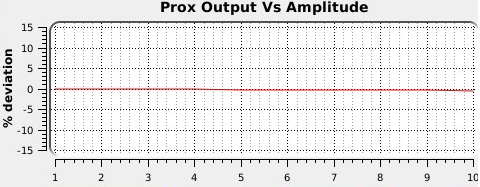
Graph View of Proximity Probe Automatic Test

Optional Accessories

Portable Vibration Calibrator

Proximity Probe Adapter Kit

  • Proximity Probe Driver Power Sourced Directly from AT2040 Battery
  • Both AC and DC voltages shown on screen.
mems-adapter

MEMS Adapter

  • Analog MEMS adapter for sensitivity readings of Piezoresistive and Variable Capacitance sensors of all major manufacturers.
  • 1x and 10 signal conditioners included.
  • Power Sourced Directly from AT2040 Battery
  • This simple and effective design supports single and double ended sensors.

We utilize best-in-class technology

Specifications

Type

Portable Vibration Calibrator / Shaker table / Accelerometer and Proximity Probe Simulator

Frequency Range

Vibration Signal: 5-10k Hz
Simulation Signal: 1 – 11k Hz

Vibration Signal

Variable frequency and amplitude

Test Types

Manual sensitivity, Sensor simulation, Automatic sweep, and Certification.

Supported Sensor Input Types

Accelerometer:
Voltage
IEPE
Charge
Velocity
Coil
Piezoresistive (MEMS Adapter Required)
Variable Capacitance (MEMS Adapter Required) 
4-20mA transmitters
Proximity probes (Direct input for AC and DC readings) (Axial / Radial)

Sensor Simulation Output

Voltage (variable frequency and amplitude)

Charge signal (variable frequency and amplitude)

4-20ma (adjustable)
Proximity probes (adjustable)

Power Output

2 to 24 volt programable voltage output to power sensors

-24 volt power to power proximity probe drivers

+24 volt power for 4-20ma sensors and transmitter type drivers

Certifications and Agency Requirements

A2LA Accredited Calibration
ISO/IEC 17025:2017
R205
NIST Traceable
LVD: EN61010-1: 2010
EMC: EN61326-1 
CE Mark: Product Specific Standard
RoHS

Request pricing and availability.


A woman on phone from agate tech support team
Scroll to Top