
Proximity Probe Calibration KitPRX-100 for Agate portable vibration calibrators
A micrometer fixture that mounts on the calibrator's front panel and holds your proximity probe over a 4140 steel target. Set the gap precisely for linear (DC) scale-factor tests, then vibrate the target for dynamic tests, all on site.
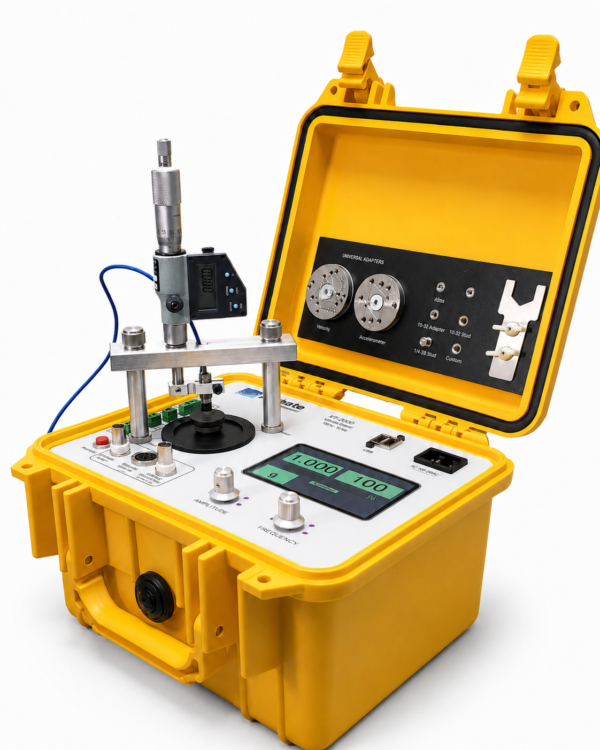
Why use the kit
Probe systems are calibrated for a target material. The kit's target is 4140 steel, the material most probe systems are set up for.
A micrometer with a non-rotating spindle moves the probe in measured steps without twisting it, for a repeatable linear test.
Step the gap for the scale factor, then vibrate the target at machine speed to check the dynamic response, without remounting.
What's in the kit
Part numbers from the AT2040 Gen 2 manual. Individual parts can be ordered as spares.
| Part | Qty | Part no. |
|---|---|---|
| Steel targetAISI 4140, screws into the reference accelerometer | 1 | PRX-102 |
| Probe arm adapter clamps⅜", ¼", 6 mm, 8 mm and 10 mm | 1 each | PRX-103 to PRX-107 |
| Mounting legs1.5", 2.0" and 3.0" | 2 each | PRX-108 |
| Proximity probe mounting bar | 1 | PRX-109 |
| Micrometer with non-rotating spindleDigital (inch and mm) or manual | 1 | PRX-110 |
| Stainless-steel thumbscrews | 2 | PRX-111 |
| Panel adaptersFit the PROX locations on the front panel | 2 | PRX-112 |
The complete kit is part number PRX-100. Once assembled, the probe should be able to touch the target and back away at least 100 mils, so choose the mounting legs to suit your probe length.
How the tests work
Scale factor over the full range
- Install the target, panel adapters, mounting bar, micrometer and probe arm.
- Connect the probe driver and set the probe 10 mils from the target.
- Step the micrometer in 10-mil increments and record the gap voltage at each step.
- The incremental scale factor (ISF) for each step shows the probe's linearity, using the Excel template on the calibrator's USB drive.
Response at machine speed
- Set the gap voltage to the middle of the probe's linear range.
- Set the frequency or RPM to match the shaft you want to simulate.
- Vibrate the target over a range such as 1 to 10 mils peak-to-peak.
- Compare the probe system's output with the displacement the calibrator applies.
The full step-by-step procedure, with an example for a 200 mV/mil probe, is in the proximity probe calibration guide.
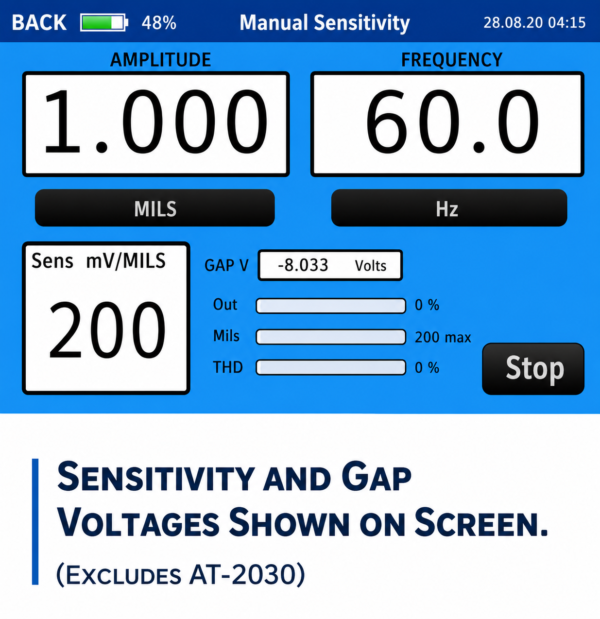
With the AT2040, the calibrator does the measuring
The AT2040 powers the probe driver from its −24 V output and reads the driver signal directly, so you need no separate supply or meter.
- Gap voltage on screen while you set the gap
- Sensitivity in mV/mil during the dynamic test
- Saved test setups for repeat probe checks
Which calibrator?
| With the kit | AT2040 | AT2030 |
|---|---|---|
| Holds the probe over the target | Yes | Yes |
| Vibrates the target | Yes | Yes |
| Powers the probe driver (−24 V) | Yes, built in | Use an external supply |
| Reads gap voltage and sensitivity | Yes, on screen | Use your own meter or monitoring system |
AT2040 portable vibration calibrator · AT2030 portable calibration shaker
Spare parts
Questions
Which probe sizes does the kit fit?
The probe arm clamps fit 6 mm, 8 mm and 10 mm probes, and ¼" and ⅜" probes. Tell us your probe model if it uses a different body size.
Why a 4140 steel target?
An eddy-current probe's output depends on the target material, and most probe systems are calibrated for AISI 4140 steel. Testing against the same material gives a meaningful scale factor.
Does the kit work with the AT2030?
Yes. The AT2030 vibrates the target and the kit holds the probe. Power the probe driver from an external −24 V supply and read its output with your own meter or monitoring system. The AT2040 does both for you.
Should I calibrate the probe on its own?
Calibrate the probe, extension cable and driver together, as they are installed, because the system is matched as a set.
Add the kit to your calibrator
Tell us which calibrator you have and which probes you test, and we'll quote the kit and any spare arms or targets you need.
Request a quote WhatsApp +1 760-215-9670 Talk to an engineer