
How to Choose a Portable Vibration Calibrator
A practical buyer's guide for reliability engineers, vibration analysts and instrument technicians: the three types of field calibrator, eight questions to ask, the mistakes to avoid, and how to match the specs to the sensors you actually test.
- A2LA accredited ISO/IEC 17025:2017
- NIST traceable
- 2-year warranty, drift & accuracy included
- Distributors worldwide
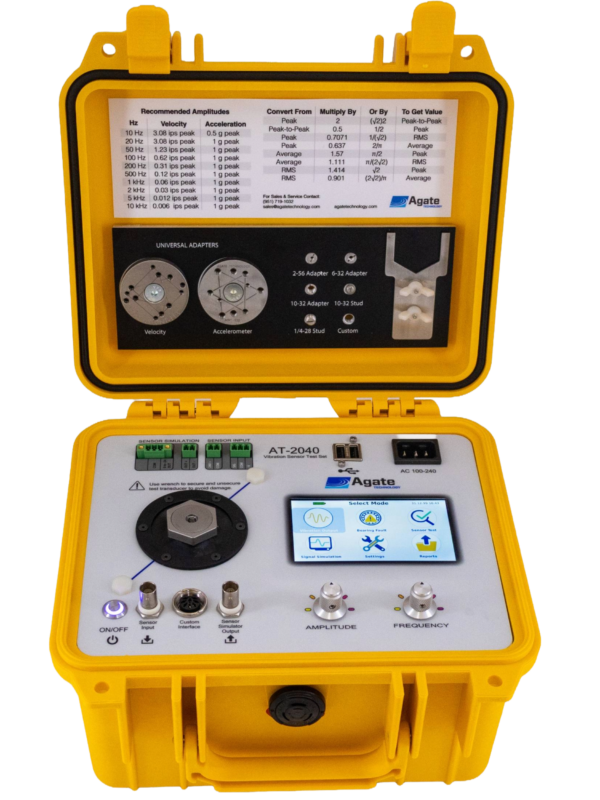 AT2040 portable vibration calibrator
- You read sensors on your own analyzer, meter or monitoring system? A portable shaker table gives you a traceable vibration to measure against. Agate's is the AT2030.
- You need the calibrator to power and read the sensor, or to produce certificates? Choose a smart calibrator. Agate's is the AT2040, which also simulates sensor signals.
- You only need a quick go/no-go check? A handheld exciter at a fixed level can be enough, but it can't check frequency response, heavy sensors or proximity probes.
What a portable vibration calibrator does
A portable vibration calibrator is a battery-powered shaker with its own reference accelerometer. It vibrates your sensor at a known frequency and amplitude, so you can compare what the sensor reports with what it should report, without removing it to a lab.
The good ones use closed-loop control: the reference accelerometer measures the real motion and the electronics adjust the drive to hold the level you set, even as frequency or sensor mass changes. That reference is itself calibrated against a higher-level standard, which is what makes the result traceable.
Field calibrators are used to verify sensor sensitivity, check a complete monitoring channel from sensor to alarm, confirm wiring, and troubleshoot suspicious readings in condition monitoring systems.
The three types of field calibrator
Pocket-sized shakers that output one or a few fixed levels, often 1 g at 159.2 Hz.
Best for: quick go/no-go checks of accelerometers and data collectors.Limits: fixed level and frequency, light sensors only, no frequency response.Variable frequency and amplitude across a wide range, with a traceable reference on screen. You read the sensor on your own meter or system.
Best for: loop checks and field calibration against a known input.Agate AT2030 →A shaker plus sensor power and inputs. They read the sensor, calculate sensitivity, run automatic tests and produce certificates.
Best for: documented calibration of many sensor types on site.Agate AT2040 →Eight questions to ask before you buy
1. Which sensors do you need to test?
List every output type you support: IEPE accelerometers, charge accelerometers, voltage and MEMS sensors, piezo or moving-coil velocity sensors, eddy-current proximity probes and 4–20 mA transmitters. Then check two things: can the calibrator vibrate them, and can it power and read them?
A calibrator with built-in sensor power (IEPE constant current, −24 V for probe drivers, +24 V for loop-powered transmitters) replaces a bag of supplies, charge amplifiers and meters.
AgateBoth units vibrate all of these. The AT2040 also powers and reads them, including MEMS and piezoresistive sensors with the MEMS-100 adapter.
2. What frequency range do your machines need?
5 Hz to 10 kHz covers most rotating machinery. Check the bottom of the range for slow-speed equipment, and the top for bearing and gear monitoring. Also check whether accuracy is specified across the whole range or only at a reference frequency.
Agate5 Hz – 10 kHz (300 – 600,000 RPM) on both, with accuracy specified across the whole range.
3. How much amplitude, displacement and payload?
Maximum output falls as sensor and fixture mass rise, and low frequencies are limited by displacement. Ask for the amplitude-versus-frequency curve at your sensor's weight. Proximity probes need enough displacement (mils peak-to-peak) at low frequency to test them meaningfully.
AgateUp to 20 g pk, payloads up to 800 g, and a maximum-amplitude chart by payload in the manual.
4. How accurate and how traceable?
Look for accuracy stated per frequency band, amplitude linearity and waveform distortion (THD). The calibrator's own calibration should be accredited to ISO/IEC 17025 by a third party such as A2LA, and NIST traceable.
Agate±2.2 % from 10 Hz to under 5 kHz, under 1 % THD typical with PureWave™ distortion correction, calibrated in Agate's A2LA accredited ISO/IEC 17025:2017 lab.
5. Do you need certificates and records?
If calibrations feed audits, quality systems or customer reports, choose a unit that runs automatic multi-point tests and exports PDF certificates and CSV data, ideally with a template you can brand.
AgateThe AT2040 runs automatic sweeps of up to 40 test points and exports PDF certificates (your logo, editable template) and CSV data to USB.
6. Is it practical in the field?
Check battery chemistry, runtime and charge time, weight, and the case. LiFePO4 batteries last thousands of cycles and charge quickly; a sealed, crush-proof case survives the truck and the plant floor.
Agate12 V 6 Ah LiFePO4 rated for about 5,000 cycles, 1-hour charge from a built-in 100–240 V AC charger, 6.24 kg in a rugged case.
7. Can it be automated?
For production lines and repeat testing, network remote control matters: plain-text commands over TCP from Python or LabVIEW, or remote operation of the screen.
AgateBoth accept TCP script commands and VNC screen control over Ethernet or Wi-Fi. The AT2040 can also run automatic sensor tests remotely, step by step.
8. What happens after you buy?
Plan for annual recalibration. Ask about turnaround, warranty (does it cover drift and accuracy?), training and local support from a distributor.
Agate2-year warranty including drift and accuracy, recalibration in our accredited lab with battery replacement as needed at no charge, training webinars, and distributors worldwide.
Quick comparison: AT2030 vs AT2040
Both Gen 2 calibrators are built on the same shaker, so the vibration they produce is identical. The difference is what happens at the sensor end: the AT2030 gives you a traceable reference to measure against, and the AT2040 also powers the sensor, reads it and documents the result.
| Question |  AT2030Portable calibration shakerA traceable vibration reference. You read the sensor on your own meter, analyzer or monitoring system. AT2030Portable calibration shakerA traceable vibration reference. You read the sensor on your own meter, analyzer or monitoring system. |
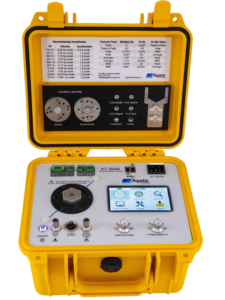 Most capableAT2040Portable vibration calibrator & simulatorThe same shaker, plus sensor power, sensor inputs, automatic tests, certificates and signal simulation. Most capableAT2040Portable vibration calibrator & simulatorThe same shaker, plus sensor power, sensor inputs, automatic tests, certificates and signal simulation. |
|---|---|---|
| 1 · Sensors you can test | ||
| Reads the sensor | Read it on your own equipment | IEPE, charge, voltage, velocity, proximity probe and 4–20 mA inputs; MEMS and piezoresistive with the MEMS-100 adapter; triaxial through the 8-pin DIN |
| Sensor power | Use an external supply | IEPE constant current (2–8 mA) · adjustable 2–23 V · −24 V probe driver · +24 V loop |
| On-screen results | Vibration level, THD and mass load | Adds live sensitivity, phase and bias / gap voltage |
| Proximity probeswith the PRX-100 kit | Vibrates the target; power and read the probe externally | Powers the driver, reads gap voltage; linear and dynamic tests |
| 2–3 · Frequency, amplitude and payload | ||
| Frequency range | 5 Hz – 10 kHz (300 – 600,000 RPM) | |
| Maximum output | 20 g pk · payload up to 800 g · displacement limited to 0.1 in (2.54 mm) pk at low frequency | |
| Units | g, m/s², in/s, mm/s, mils, mm, µm · peak or RMS · Hz or RPM | |
| 4 · Accuracy and traceability | ||
| Acceleration accuracy | ±2.2 % (10 Hz – < 5 kHz) · ±3.2 % (5 – 9 Hz) · ±3.0 % (5 – 10 kHz) | |
| Waveform quality | PureWave™ distortion correction, < 1 % THD typical up to 5 g pk | |
| Traceability | A2LA accredited ISO/IEC 17025:2017 calibration · NIST traceable reference accelerometer | |
| 5 · Certificates and records | ||
| Automatic tests | Manual checks | Multi-point sweeps of up to 40 test points from an onboard sensor database |
| Certificates & data | Record results yourself | PDF certificates with your logo (editable template) · CSV export to USB |
| Simulation | ||
| Signal simulation | Not available | 1 Hz – 11 kHz: IEPE, charge, voltage, velocity, proximity probe and 4–20 mA signals into your monitoring system |
| Bearing fault simulation | Not available | Outer race, inner race and cage faults with adjustable ball count |
| 6 · Field use | ||
| Battery & charging | 12 V 6 Ah LiFePO4, about 5,000 cycles · 1-hour charge · built-in 100–240 V AC charger | |
| Size & weight | 10.6 × 9.7 × 6.9 in (27 × 24.6 × 17.4 cm) · 6.24 kg · 4.3" touchscreen and two dials | |
| 7 · Automation | ||
| Remote control | Ethernet or Wi-Fi: TCP script commands and VNC screen control | Same, plus remote sensor tests with step-by-step control and CSV results |
| 8 · After you buy | ||
| Warranty & support | 2 years, including drift and accuracy · annual recalibration recommended · training webinars and email support | |
| AT2030 details | AT2040 details Get a quote | |
Accuracy figures apply to sine output. Maximum amplitude by payload and frequency is on each product's datasheet.
- you already read sensors on a meter, analyzer or monitoring system
- you mainly do loop checks and spot checks in the field
- you don't need certificates from the calibrator itself
- you want one case that powers, reads and calibrates the sensor
- you need PDF certificates and CSV records for audits or customers
- you test proximity probes or 4–20 mA transmitters, or simulate signals
Try both calibrators in your browser

Use the real interface before you buy
Each product page runs a working copy of the touchscreen. Set a frequency and amplitude, switch units, start a test or a simulation, and see exactly what your technicians will use.
Try the AT2040Try the AT2030Six mistakes to avoid
- Comparing frequency range alone. Two calibrators that both say 5 Hz – 10 kHz can deliver very different levels once a real sensor is mounted. Compare the amplitude-versus-frequency curve at your sensor's weight.
- Forgetting the payload. Velocity sensors, triaxial blocks and mounting fixtures can weigh hundreds of grams. Add them up and check the maximum payload and the level available at that mass.
- Testing proximity probes the wrong way. A probe system is calibrated for one target material, normally AISI 4140 steel as specified by API 670. Test against that material, with enough displacement at low frequency and a way to power the driver and read the gap voltage.
- Treating "traceable" as "accredited". Traceability describes the chain of comparisons. Accreditation to ISO/IEC 17025 by a body such as A2LA confirms the lab behind the calibrator is competent. Ask for both.
- Checking at one frequency only. A single check at 159.2 Hz confirms sensitivity at that point but misses problems in the frequency response, mounting resonances and low-frequency faults. A multi-point sweep catches them.
- Ignoring what happens after the sale. Your calibrator needs its own recalibration every year. Find out who does it, whether the warranty covers drift and accuracy, and whether there is local support.
Which Agate calibrator fits?
Answer three questions
We'll suggest the AT2030 or AT2040, the accessories you'll need, and tell you why.
What comes with every Agate calibrator
Calibrated in Agate's A2LA accredited ISO/IEC 17025:2017 lab, NIST traceable.
Covers drift and accuracy, not just parts and workmanship.
¼-28 and 10-32 studs, 2-56, 6-32 and 10-32 adapters, universal accelerometer and velocity adapter discs, and a short-handle wrench.
We replace the battery as needed at no charge when the unit comes in for recalibration.
New features and fixes install from a USB flash drive.
Training webinars, email and phone support, and distributors worldwide.
FAQ
What is the difference between a vibration calibrator and a shaker table?
The terms overlap. A portable shaker table generates a controlled, traceable vibration that you measure your sensor against. A vibration calibrator usually means a shaker plus electronics that also power and read the sensor and calculate its sensitivity for you.
What is the difference between the AT2030 and the AT2040?
Both use the same Gen 2 shaker: 5 Hz to 10 kHz, up to 20 g pk and ±2.2 % accuracy from 10 Hz to under 5 kHz. The AT2030 is a traceable vibration reference that you read with your own equipment. The AT2040 adds sensor power and inputs, live sensitivity, automatic tests with PDF certificates, signal simulation and bearing fault simulation.
What frequency range do I need?
Match it to the machines you monitor. 5 Hz to 10 kHz covers most rotating machinery and accelerometer checks. Slow-speed equipment needs good low-frequency performance, and high-frequency bearing and gear monitoring needs the top end.
Why do handheld calibrators use 159.2 Hz?
At 159.2 Hz the angular frequency is about 1,000 rad/s, so 1 g (9.81 m/s²) corresponds to 9.81 mm/s of velocity and 9.81 µm of displacement, all peak values. One setting can then check acceleration, velocity and displacement channels. It is a convenient single point, not a frequency response test.
Can a portable calibrator test proximity probes?
Yes, if it can produce enough displacement at low frequency and you have a probe mounting kit. A calibrator that also powers the probe driver (−24 V) and reads gap voltage lets you check both static and dynamic response on site.
Can I calibrate 4–20 mA vibration transmitters in the field?
Yes. Mount the transmitter on the shaker, apply a known vibration and read the loop current. The AT2040 supplies the +24 V loop power and reads the current directly; with the AT2030 you use your own loop supply and meter.
How often should a portable vibration calibrator be recalibrated?
Typically once a year, by an ISO/IEC 17025 accredited lab, so its own reference stays traceable.
Do I need a calibrator that creates certificates?
If you calibrate sensors for records, audits or customers, yes. Automatic PDF certificates and CSV data save time and avoid transcription errors. If you only spot-check sensors against a known level, a reference shaker is enough.
Not sure which one you need?
Tell us which sensors you test and how you record the results. An Agate engineer will recommend the right calibrator and accessories, and send you a quote.
Request a quote WhatsApp +1 760-215-9670 Talk to an engineer Prefer a local partner? Find an Agate distributor near you.More guides: How often should accelerometers be calibrated? · Accelerometer bias voltage troubleshooting · Proximity probe calibration: wobulator vs shaker